Wednesday, July 1, 2009

Portland Prices Continue to Slide in April - Case Shiller


The April Case Shiller data was released yesterday and April's median price for an existing home in Portland was down 16% from April 2008. (click on any chart to expand it to readable size)

The monthly change was down 0.6% from March, much less than the 2.1% drop from February to March 2009. Don't take this as a sign that prices are stabilizing, this is just the typical spring "bounce" as flowers bloom and sellers get a little crazy.

The median Portland home price is now down 21.3% from the peak in July 2007, and prices continue to decline.

At this point if I would predict prices will continue to decline through 2009 and well into 2010.


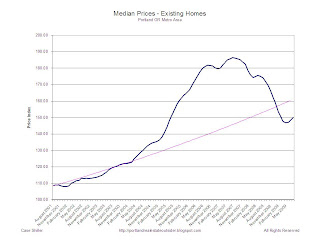
The chart above shows the price index for the past five years. We are still looking at the same prices seen back in June 2005, almost 4 years ago

The above chart shows growth rates for Portland, Seattle, the San Francisco bay area (the other areas I consider as closest to Portland) as well as the 20-city composite index. Portland and Seattle are still tracking each other very closely, however in April Seattle saw a slight uptick in prices, while Portland prices continued to decline. This might reflect Oregon's record unemployment, or just a momentary anomaly. We'll have to wait and see if it turns into a trend.

While the price declines for the overall market appears to have hit bottom, Portland and Seattle price declines continue to set new records. The price declines in the SF Bay Area also seem to have bottomed out and are now slowing. Prices are still declining, just not as fast as in previous months.

February was the first month where the price decline didn't set a new record for the SF Bay Area and for the overall 20 city index. The 20 city index peaked in July 2006, while Portland peaked a year later in July 2007.

This chart shows the price index for the past 8 years. I also added a line in pink that represents an average of 5% growth starting in January 2001. You can see that the current price index is now below the 5% average growth line. An over-correction is to be expected, but we are also probably correcting to a more reasonable 3-4% long term growth rate, or about the rate of inflation. But it's likely that we'll over correct before getting there.

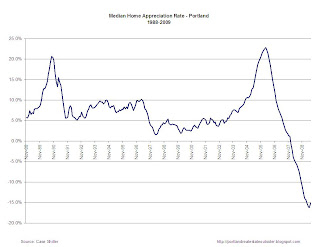
This chart shows the previous bubble in the early 90's, and also shows that Portland prices had never dropped over the past 20 years, until 2008. But as they say, past performance is no guarantee of future performance!


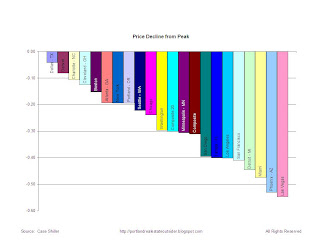
The above chart is a new addition. It shows how Portland is faring compared to other cities. Our maximum price decline is still below average, but as we all know Portland was late to this party, a party most homeowners didn't want an invitation to. I predict we will be worse than average shortly.

{Note, my apologies for the slow posting. Work has continued to keep me busy and I'd much rather be overworked right now than unemployed, but it has cut into my personal time}

ABOUT CASE SHILLER:
The S&P/Case-Shiller Home Price Indices measures the residential housing market, tracking changes in the value of the residential real estate market in 20 metropolitan regions across the United States. These indices use the repeat sales pricing technique to measure housing markets. First developed by Karl Case and Robert Shiller, this methodology collects data on single-family home re-sales, capturing re-sold sale prices to form sale pairs. This index family consists of 20 regional indices and two composite indices as aggregates of the regions.

Monday, June 1, 2009

Ferris Bueller's Friends House For Sale - $2.3M


If anybody is in the market for some property in Chicago, this cool place is up for sale for only $2.3M It was the house that Ferris' sidekick Cameron Frye lived in. I hate to say it's a stunning house, anybody wanna lend me $2.299999999999M?

No the Ferrari doesn't come with it, it was fake anyway. The real thing is worth more than the house.

(apologies for the lack of posting lately, I've been slammed with a big project at work, and trying to enjoy a little sun when I'm not working!)

Add to Technorati Favorites

Wednesday, May 27, 2009

Sixth time is the charm - 3131 NE Grant finally sells


I lost count of how many times this place went into escrow, but apparently it finally found a new owner for $820k. No info as to whether than included the furniture, Mercedes, or anything else, but it sure has been quiet around here since the original post faded away.

Original post: High End Sellers Freaking Out - 3131 NE Grant Place

Add to Technorati Favorites

Tuesday, May 26, 2009

Portland Existing Home Prices Drop 15.3% in March - Case Shiller

The March Case Shiller data was released today and March's median price for an existing home in Portland was down 15.3% from March 2008. (click on any chart to expand it to readable size)

The monthly change was down 2.1% from February, about the same as the 1.9% drop from January to February.

The median Portland home price is now down 20.8% from the peak in July 2007.


The chart above shows the price index for the past five years. I had to go beyond 3 years as we are now staring at the same prices seen back in June 2005, almost 4 years ago

The above chart shows growth rates for Portland, Seattle, the San Francisco bay area (the other areas I consider as closest to Portland) as well as the 20-city composite index. Portland and Seattle are tracking each other very closely, still about a year behind the rest of the market.

While the price index continues to fall everywhere, the growth rate (or decline rate) for the 20-City index as well as for the San Francisco Bay Area markets appears to have reached an inflection point. We need a few more months of data before calling it a trend, but it looks like there are signs of a bottom approaching for the Bay Area as well as the rest of the country.

February was the first month where the price decline didn't set a new record for the SF Bay Area and for the overall 20 city index.

This chart shows the price index for the past 8 years. I also added a line in pink this month that represents an average of 5% growth starting in January 2001. You can see that the current price index is now below the 5% average growth line. An over-correction is to be expected, but we are also probably correcting to a more reasonable 3-4% long term growth rate, or about the rate of inflation. But it's likely that we'll over correct before getting there.

This chart shows the previous bubble in the early 90's, and also shows that Portland prices had never dropped over the past 20 years, until 2008. But as they say, past performance is no guarantee of future performance!

What else would you guys like to see? Any predictions on when/where we'll see the price bottom?

{Note, my apologies for the gap in posting. My folks were in town, then my company decided to give me a huge project to work on. I'm not complaining, I'd much rather be overworked right now than unemployed, but it has cut into my personal time}

ABOUT CASE SHILLER:
The S&P/Case-Shiller Home Price Indices measures the residential housing market, tracking changes in the value of the residential real estate market in 20 metropolitan regions across the United States. These indices use the repeat sales pricing technique to measure housing markets. First developed by Karl Case and Robert Shiller, this methodology collects data on single-family home re-sales, capturing re-sold sale prices to form sale pairs. This index family consists of 20 regional indices and two composite indices as aggregates of the regions.


Add to Technorati Favorites

Tuesday, May 5, 2009

Portland Housing Prices 29% Overvalued - OFHEO


I found a cool site today that allows you to chart the OFHEO Home Price Index against a local regions median income. (click on chart to expand)

In the chart you can see how the two normally follow each other quite closely, but obviously recently the two data sets have moved apart significantly.

You can easily play with the charts to check out other areas like Seattle, Bend, etc.

Add to Technorati Favorites

Monday, May 4, 2009

Bend Recession Proof?

My wife found this little gem of an article today, and while I wasn't there when she did, I'm pretty sure she spit her tea all over her PC when she saw this:

Yup, this article is claiming that Bend is "recession proof." Never mind the 16% unemployment rate at the moment.

I guess when you create your own definitions you can pretty much say whatever you want. Their definition?

Not more than 9 months of recession over the past 15 years. If we apply that definition again next year I don't think any area would qualify.

Does journalism require any qualifications anymore?


Add to Technorati Favorites

Thursday, April 30, 2009

A successful flip?

What defines a successful flip?

A reader made this comment on one of the earlier posts:

"I was poking around in NE this weekend and found a couple interesting recent high end flips that appeared to have worked.

1928 NE 26th. Paid $375K on 4/25/2008. Pending sale at $765K.

2028 NE Alameda. Paid $875K on 2/14/2007. Pending at $1,495,000.

3117 NE 32nd. Paid $270,000 on 4/2/2007 and closed for $785K on 2/19/2009.

These do seem to be the exception rather than the rule though. They are all well located (no busy streets, etc.) and the rehabs appear to be well done."
The house on 32nd was especially interesting. Take a look at the before photo:

And then the after photo:


Yes it's the same house, but it looks like 80% of it is new. They added up as well as out. Unfortunately I don't know who did the work.

On the surface it loks like a nice remodel, but something about the details stuck me as odd.

The kitchen is nice, if a little generic. I guess for 3/4 of a million I would expect a bit more.


But then I saw this room (I assume it's the dining room). The room just strikes me as odd. Personally one of my favorite features of old craftsman homes are these cabinets and columns that seperate the living and dining rooms. But seriously, what were the "architects" thinking here? Did someone screw up?

First off, why are the cabinets so small? They're perfect for showing off your fine china to your toddler. And the built in's in the back of the dining room? Not really built in, they look like generic home depot cabinets smacked on a wall. But the kicker is the columns. They don't reach the ceiling! That looks like a major goof to me, and I'm pretty sure the base cabinets were supposed to be a little bit bigger. Oops.

All in all, I'd expect a lot more for $785k. For the builder I think it was a successful flip, if not a slam dunk after all their costs. But for the buyer? I'd take the house at 3311 Tillamook over this one, and pocket the $200k difference. At least you're getting a real vintage craftsman foursquare with more pleasing proportions, old growth wood trim, a bigger house and a bigger lot.


These are real built-ins.


Add to Technorati Favorites